
Red, Orange, Green: Understanding Kids’ Tennis Stages

  • , ,
    Red, Orange, Green: Understanding Kids’ Tennis Stages

    by Jeff Rockwell, Tennis Instructor at Osler Bluff Ski Club

    A father stands at the fence on a Saturday morning and watches his six-year-old rally. The ball is red and soft and a little oversized. The court is short, the net is low, and his daughter is sending four, five, six balls in a row back over it, laughing somewhere in the middle of the streak.

    Then he leans toward me and asks the question I hear almost every week. When does she get to use a real ball.

    It is a fair question. It also carries a quiet worry underneath it. The worry is that the red ball is a beginner’s toy, that the short court is a waiting room, and that the faster his daughter is moved along, the better she must be doing.

    Here is the part worth saying at the start. The colours in kids’ tennis are not a ranking of talent. They are equipment, sized and slowed to fit a child’s body and a child’s eyes. A six-year-old rallying happily with a red ball is not behind anyone. And rushing to the next colour, in my experience, is one of the more reliable ways to make a young player worse.


    Find and compare tennis programs and clubs on the GoPlay platform. Registration is free. Visit: app.goplay.ai or click the button below


    What Progressive Tennis actually is

    For most of the sport’s history, kids learned tennis by being handed a shrunken version of the adult game. A full court that stretched out like a parking lot. A yellow ball that came off the racquet fast and bounced up around their ears. A racquet built for a grown adult’s arm. The child adapted or the child quit, and a lot of them quit.

    Progressive tennis flips that around. Rather than shrinking a child down to fit the adult game, it scales the game to fit the child. Smaller courts, lighter and slower balls, racquets sized to the player, all staged so a five-year-old can actually rally and play points from the first session. Tennis Canada describes it plainly as a collection of adaptations that make tennis more accessible, enjoyable and easier to play.

    This is not a Canadian invention, though Canada has leaned into it hard. It grew out of the International Tennis Federation’s Play and Stay work, which now shapes how young kids start the game around the world. In Canada it shows up most visibly in Tennis Canada’s Rogers First Set program, built on the same red, orange and green stages you will see on club schedules across the country.

    So when your child is put on a red ball, they are not being kept out of tennis. They are being handed the version of it that lets them play tennis today.

    Red, Orange, Green, and the Green Dot

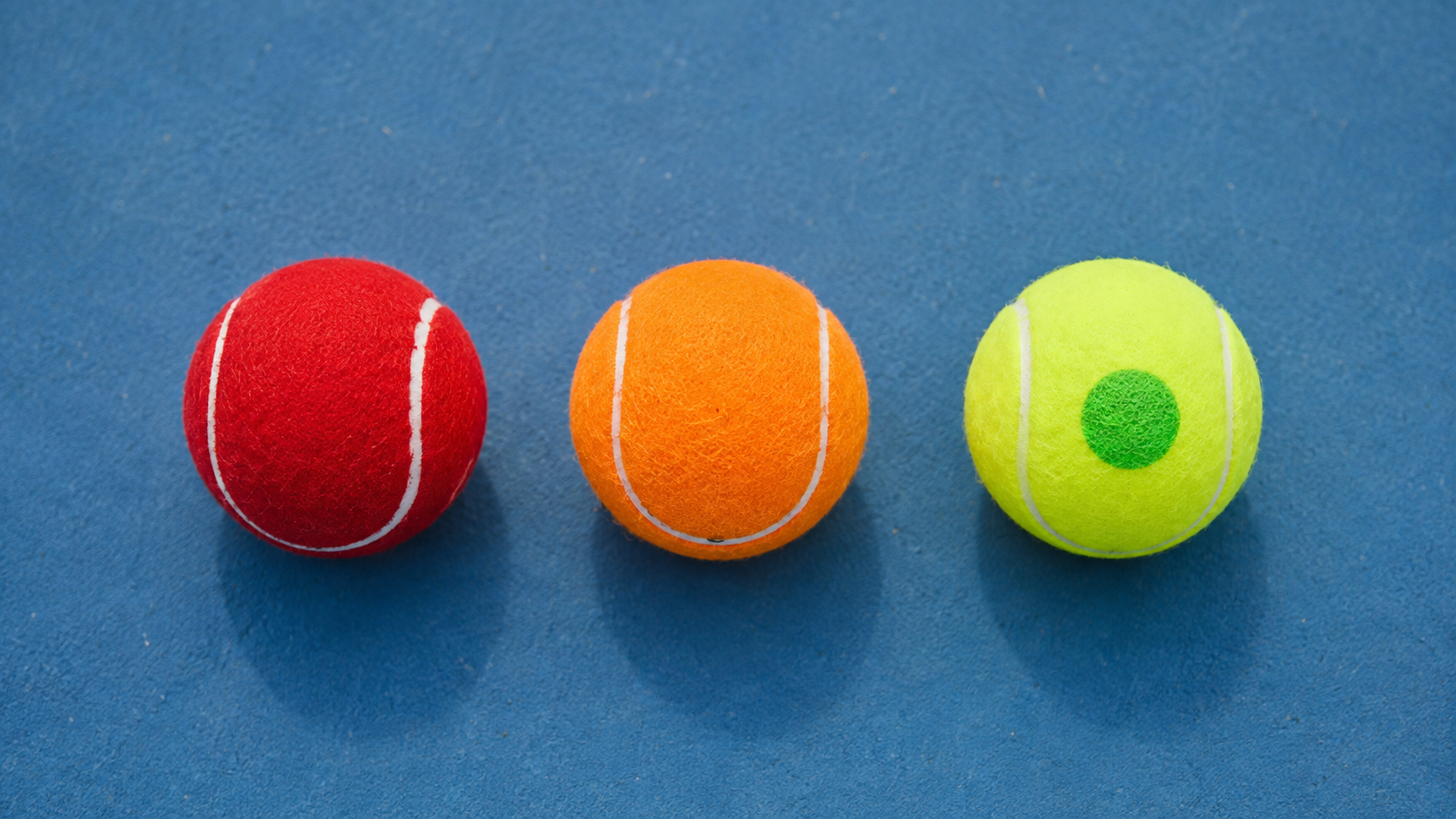
    The colours describe the ball, and the ball sets almost everything else. Here is what each one actually means, in plain terms.

    The red ball is the slowest and softest. It is foam or low-pressure felt, a little larger than a standard ball, and it travels roughly seventy-five percent slower than a yellow one. It lives on a short court, about the width of a doubles court laid sideways, with a low net. This is where the youngest kids start, often around ages five to eight.

    The orange ball is the next step up. It moves about fifty percent slower than a yellow ball and plays on a three-quarter court. A child on orange is usually starting to cover more ground and rally with a bit more shape.

    The green ball is where things get close to the full game. It is the same size and weight as a standard yellow ball but with about twenty-five percent less pressure, so it flies and bounces a touch slower. You will often hear it called a “green dot” ball, because it is marked with a small green dot to tell it apart from a full-pressure yellow ball that looks identical. Green plays on a full-size court with a regular net. It is the last stop before a child is hitting with a standard yellow ball on the same court the pros use.

    Notice what is changing as the colours move. The ball speeds up, the court grows, and the racquet lengthens. Every one of those changes asks more of the player. That is the whole design. Each colour hands a child a challenge they can actually meet, then hands them a slightly bigger one when they are ready for it.

    Why a slower ball teaches faster

    This is the part that feels backwards to a lot of parents, so it is worth sitting with.

    A faster ball does not teach a child faster. It usually teaches them worse.

    Watch what happens when you put a small beginner on a full court with a real yellow ball. The ball arrives before they are set. It bounces up past their shoulder. They reach, they lunge, they slap at it late, and they miss most of them. What they are learning in that moment is not tennis. It is panic, and a rushed, arm-only swing that a coach then has to spend years undoing.

    Now slow the ball down and shrink the court. Suddenly the child has time. The ball meets them at a comfortable height, out in front of their body where a good contact point lives. Research on scaled tennis equipment has found exactly this. When young beginners use lower-compression balls and appropriately sized racquets, they make contact in front and to the side of the body and swing from low to high far more often, which is the foundation of every real groundstroke. They also simply hit more balls back, and rallying is how the game is learned.

    Parents often assume the harder ball is the more advanced training, the way heavier weights mean a harder workout. In reality, the slower ball is not making tennis easier. It is making tennis learnable. The speed comes later, once the movement underneath it is sound.

    The colours are about equipment, not a report card

    If there is one idea to carry out of this article, it is this. The colour of your child’s ball tells you what equipment gives them the best chance to learn right now. It does not tell you how talented they are, and it is not a grade.

    Two kids the same age can sit at different colours for reasons that have nothing to do with ability. One has been playing since she was four. One picked up a racquet last month. One is tall and coordinated for his age. One is still growing into his feet. None of that is a verdict on how good they will be at twelve, or sixteen, or thirty-five.

    This matters because the pressure to move up is real, and it almost never comes from the child. It comes from the fence. A parent sees another kid on orange and reads it as a scoreboard. The trouble is what moving up too soon actually does. It takes a child who was rallying with confidence and margin and drops them into a ball moving faster than they can read, on a court bigger than they can cover. The rallies collapse. The swing shortens back into a panic-slap. The fun leaks out.

    A child who is a little bored on red is fine. A child who is drowning on orange is a problem that can take a season to fix.

    Age tells you where to start, not when to move

    The stage charts all list age ranges, and those ranges are useful. A five-year-old belongs on red. A ten-year-old who has never played does not belong on a full-pressure yellow ball just because of the number on their birthday cake. Every youth sport runs into this. It is the same tension behind the U-age brackets in Canadian soccer, where the birth year sets the group and everything else sets the player.

    But age is where you start the conversation, not where you end it. Two things matter more than the calendar. The first is the body, meaning size, strength and coordination. The second is time in the sport, meaning how many hours a child has actually spent rallying. A tall, athletic eight-year-old who has played for two years and a small seven-year-old in her first month might both be exactly where they should be, on two different colours.

    Children do not graduate to the next ball because they had a birthday. They progress because they are ready. Those are different things, and the difference is the entire point.

    How a coach knows a child is ready

    So how do we actually decide. Not by age, and not by how badly a parent wants it. We watch four things.

    We watch whether the rally holds. A child who is ready to move up can keep a ball going with a partner without the point falling apart every second shot. We watch the contact point, whether they are meeting the ball out in front or still catching it late and cramped. We watch court coverage, whether they can recover after a shot and get to the next ball, because the next colour will hand them more ground to cover. And we watch decisions, whether they are starting to aim the ball somewhere on purpose rather than just getting it back.

    Put simply, a child is ready to move up when the current stage has become comfortable and a little too easy. They are winning points with room to spare. The challenge has drained out of it. That is the moment the next ball helps, because it restores the challenge without tipping into chaos.

    You can usually see the right stage from the fence, too. Your child is in the right place when the rallies are happening, when they are being stretched but not overwhelmed, and when they still want to come back next week. That last one is the most important reading on the dial.

    Choosing a tennis program that keeps a kid playing

    Not every program runs progressive tennis well, so it is worth knowing what good looks like before you enrol.

    Look for coaches who use the staged equipment on purpose and can explain why, not ones who put every kid on a yellow ball because that is what a real racquet club looks like. Look for small groups and a lot of actual ball-striking, kids rallying and playing points early, rather than long lines waiting for a turn. Look for an environment built around fun and long-term participation instead of early results, because the healthiest young player is simply the one who is still playing in ten years. A program running Rogers First Set, or built on the same red-orange-green model, is usually a good sign.

    And ask one direct question. How do you decide when a child moves up. A good coach will have a real answer about rallies and readiness. If the answer is only about age, keep looking. It belongs on the short list of questions worth asking before you register anywhere.

    I made the broader case for the sport elsewhere, in is tennis the healthiest sport for kids? The short version is that tennis is one of the few games a person can play at six and at sixty. The colours exist to get your child onto that path and keep them there.

    The colours were never the point

    It is easy, standing at the fence, to turn a child’s tennis into a ladder and start counting the rungs. Red, then orange, then green, then the real thing, faster please.

    But the ladder was never the point. The point is a child who reaches for a ball she has no business getting to, gets a racquet on it, sends it back, and laughs. The colour under that moment will change on its own, quietly, at the right time, and you will barely notice the day it happens. What you will notice is a kid who wants to play again tomorrow. Get that right and the rest takes care of itself.


    Find and compare tennis programs and clubs on the GoPlay platform. Registration is free. Visit: app.goplay.ai or click the button below


    Frequently Asked Questions

    What do the red, orange, and green tennis balls mean?

    They are the stages of progressive tennis, and each colour is a ball scaled to a child’s stage of development. Red is the slowest and softest and plays on a short court, orange is a step faster on a larger court, and green is close to a full yellow ball on a full court. The colours change the speed of the ball and the size of the court so a child is always playing a version of tennis they can actually rally in. They describe the equipment a child is using, not how good they are.

    What age should my child start with a red ball?

    Most children start on red somewhere around ages five to eight, and some age-appropriate programs begin even younger. The red ball is soft, slow and a little oversized, which lets a young child track it and hit it without feeling rushed. Age is only a starting guide, though. What matters more is that the child can rally and enjoy it, which the red ball is designed to make possible from the first session.

    When should my child move up to the next ball colour?

    When the current stage has become comfortable and a little too easy. A child is ready when they can keep a rally going, meet the ball out in front, cover the court, and start placing shots on purpose, all with room to spare. Moving up before that trades a confident player for an overwhelmed one. There is no prize for reaching yellow early, so let readiness lead.

    Is the red ball too easy for my child?

    If your child is rallying well and clearly winning points with margin, the red ball may have done its job, and that is worth mentioning to their coach. But “too easy” is exactly the right condition to be in just before moving up, not a sign the stage was a waste. A child who looks like they are cruising on red is building the movement and contact that the faster balls will demand later. Boredom is a signal to progress, not proof the colour was beneath them.

    Can my child skip a stage?

    Occasionally, but it is rare and it should be a coach’s call, not a shortcut. The stages exist because each one builds something the next one needs, so skipping usually just moves a gap further down the road. A child who arrives with real experience from another racquet sport might slot in higher than their age suggests. For most kids, moving through the stages in order is what makes the progress stick.

    What is a green dot ball, and how is it different from a regular tennis ball?

    A green dot ball is the same size and weight as a standard yellow ball but has about twenty-five percent less internal pressure, so it flies and bounces a little slower. It is marked with a small green dot precisely because it looks identical to a full-pressure yellow ball otherwise. That small drop in speed is enough to help a child transitioning to the full court keep control while they adjust. It is the last step before a standard yellow ball.

    Does my child need a different racquet for each stage?

    Racquet length does increase as children move through the stages, roughly from nineteen to twenty-three inches at red up toward twenty-six inches at green. A racquet sized to the child helps them swing properly rather than muscling an adult frame around. You do not need anything expensive, and many programs supply appropriately sized racquets for beginners. It is worth checking the length matches your child’s stage before buying, and worth knowing what a season in youth sport tends to cost before you commit to more than one.

    My child is tall for their age. Should they be on a faster ball?

    Not automatically. Height helps with reach, but it does not by itself give a child the timing, coordination and rally consistency that the faster balls demand. A tall beginner still needs to learn to meet the ball out in front and control a rally, and the slower ball is where that gets built. Let the coach base the decision on how your child is actually playing, not on how they measure up.

    What is Rogers First Set?

    Rogers First Set is Tennis Canada’s national program for introducing kids to the game, delivered with partners and community coaches across the country. It is built on the red, orange and green progressive tennis stages, with the goal of letting young players rally and enjoy tennis from the start rather than waiting until they can handle a full court. If a local program runs it, that is usually a good sign the equipment and coaching are matched to young players. You can compare local tennis programs and clubs on GoPlay to find options near you.

    How do I know if my child is in the right stage?

    Watch the rallies and watch their face. A child in the right stage is being challenged but not overwhelmed, hitting plenty of balls back, and still wanting to come back next week. If every point collapses in a scramble, the stage may be too fast for now. If they look bored and are winning easily, they may be ready to move up, which is a conversation to have with their coach.

  • ,
    Is Tennis Really the Healthiest Sport in the World?

    A Canadian Parent’s Guide

    Jeff Rockwell, Tennis Instructor, Osler Bluff Ski Club

    On a warm evening in July, a public court fills up the way it always does. A parent leans on the fence and watches an eight-year-old chase down a ball she has no business reaching, get a racquet on it, and send it back over the net by accident. She laughs. She sets up again.

    You have probably seen the headline by now. Tennis, the healthiest sport in the world. It shows up on club websites, in tournament marketing, in the little facts that get passed around at the side of the court.

    It is a good line. The question is whether it is true.

    The honest answer is that no one hands out a title like that. There is no governing body that ranks every sport against one agreed definition of health, and much of the research behind the claim comes from adults, not children. What is true is quieter and more useful. Few activities ask as much of the body and the brain at the same time as tennis does. Cardio, strength, agility, coordination, quick decisions, and the social pull of a game you can keep playing into your seventies. For a Canadian kid, that combination is the part worth paying attention to.


    Find and compare tennis programs and clubs on the GoPlay platform. Visit: app.goplay.ai or click the button below.


    What “healthiest” actually means

    The word does a lot of work in that headline, and it hides a question. Healthiest by what measure.

    You could mean cardiovascular health. You could mean low injury risk, or mental health, or how long people who play tend to live. You could mean strength, or affordability, or how easy it is to find a court. You could mean the thing that matters most and gets measured least, which is whether a child is still playing ten years from now.

    Depending on which of those you pick, the “healthiest sport” changes. Swimming looks great on one list. Walking looks great on another. Tennis happens to score well on several of them at once, which is part of why the claim has stuck. That is a real strength. It is not the same thing as a scientific title.

    So it helps to treat “the world’s healthiest sport” as a compelling argument rather than a settled fact. The argument holds up better than most marketing does. It just deserves to be read as an argument.

    What tennis asks of a child, all at once

    Stand behind a court for ten minutes and watch what one rally actually requires.

    A player reads the ball off the opponent’s racquet and decides, in a fraction of a second, where it is going. Then the body moves. A few quick steps, a plant, a change of direction, a stretch to reach. There is a burst of speed and then a stop, then balance recovered, then the swing itself, which pulls in the legs, the core, the shoulder and the arm in sequence. Then it resets and does it again, differently, because the next ball is never quite the same.

    That is the part the statistics tend to flatten. Tennis is not one kind of exercise. It is aerobic movement and short anaerobic bursts. It is acceleration and deceleration. It is lateral and multidirectional movement rather than the straight lines of running. It is balance, coordination, reaction time and decision-making, layered on top of the weight-bearing work that helps growing bodies build bone.

    Parents often assume the health benefit of a sport comes down to how hard a child is breathing. In reality, the more interesting benefit here is how many systems are working together. A child on a tennis court is training the heart, the muscles, the skeleton and the brain in the same rally. That variety is the case for tennis. The impressive numbers are just the shadow it casts.

    The longevity research, read honestly

    This is where the healthiest-sport claim gets its headline power, and where it needs the most care.

    Large, long-running studies have linked racquet sports, and tennis in particular, to notably better long-term health outcomes. Lower risk of dying from cardiovascular causes. In one well-known Danish study, an estimated life-expectancy advantage for regular tennis players that runs to several years. Reviews of the research also point to better aerobic fitness, healthier body composition, improved cholesterol profiles and stronger bones.

    Those findings are real, and they are worth knowing. They also come with two honest caveats that a good parent’s guide should not skip.

    The first is that much of this research groups tennis with other racquet sports, such as badminton and squash. It tells us the family of sports is associated with good outcomes. It does not prove tennis alone produced them.

    The second is bigger. These are observational studies of adults. People who play tennis into middle age tend to differ from people who do not, in income, in social connection, in diet, in a dozen other health habits. The sport is tangled up with the kind of life that surrounds it. So the studies show a strong association, not a clean cause.

    Which means there is one sentence this article will not write. Children who play tennis will live longer. We do not know that, and no responsible reading of the research says it. What we can say is smaller and still meaningful. Tennis is associated with long, healthy lives, and giving a child a sport they can keep playing for decades is a reasonable bet on a lasting habit. That is the claim the evidence supports. It is enough.

    The reason to keep showing up

    There is a part of the tennis story that has nothing to do with heart rate.

    Tennis is an individual sport in the sense that responsibility sits with one player. It is rarely a solitary one. Kids learn it with a coach, rally with a partner, drill in a group, and play against an opponent who is also, usually, a friend from the same club. The sport comes wrapped in people.

    Researchers looking at why racquet and partner sports do so well in longevity studies have offered a plain explanation. The social contact might be part of the medicine. Tennis Canada makes a similar case when it talks about the sport in terms of friendships, confidence, resilience and strategic thinking rather than fitness alone.

    That gives the whole thing a shape worth holding onto. Tennis exercises the body, challenges the brain, and gives a child a reason to keep coming back to the same court and the same people. The health benefit and the social benefit are not two separate things. The second is what makes the first last.

    Why this matters more in Canada

    Here is the part that turns an interesting sport into a useful one for Canadian families.

    Most Canadian kids are not moving enough. National guidelines recommend that children and youth aged five to seventeen average at least sixty minutes of moderate-to-vigorous activity a day, and by ParticipACTION’s most recent Report Card, most are not getting there. Activity also tends to fall as kids get older, with adolescents the least active group of all.

    That reframes the question. It is not really “is tennis good for you.” Almost any activity a child enjoys and sticks with is good for them. The better question is which activities a child can carry past the teenage drop-off and into adult life.

    This is where tennis earns its place. It is one of a small set of sports a person can play at six and at sixty. A child who learns it is not just getting exercise this season. They are being handed something they can still use when the organized leagues are long over. For a country where activity levels sag through adolescence, a sport with that kind of shelf life is worth more than its cardio numbers suggest.

    How Canadian kids actually start

    One worry sits underneath a lot of parents’ hesitation about tennis. It looks like an adult game. A full court is enormous for a small child, the ball moves fast, and the whole thing can seem like something you graduate into rather than start.

    Canadian tennis has spent years designing its way around exactly that problem, and it is the detail that makes this a genuinely Canadian story rather than one borrowed from somewhere warmer.

    Tennis Canada’s Rogers First Set program is built on progressive tennis. Smaller courts, lighter and lower-compression balls, racquets sized to the child. The point is not to produce a champion. It is to let a five-year-old actually rally, feel the game, and have fun early. Its newer Whole Player Development Pathway takes a wider view again, focusing on developing the person alongside the player, with red, orange and green stages that let young kids make decisions and play real points sooner. There is even a curriculum built for children aged three to five, which adapts the activity to the child rather than shrinking an adult sport down and hoping it fits.

    The practical takeaway for a parent is reassuring. The health benefits of tennis do not require full-court, competitive play. Modern Canadian programs change the court, the ball and the racquet so a young child can move, rally and enjoy the game from the very first session. Your kid does not need to look like the players on television to get almost everything that matters out of the sport.

    The case for tennis as a second sport

    There is one more angle here, and it comes from coaching two sports at once.

    I have spent a lot of my life on both tennis and volleyball courts and the overlap between them is hard to miss. This part is a coaching perspective built on what I see, not a claim from a study, and it is worth taking on those terms.

    My point is about the calendar. Canadian kids spend the cold months in hockey, basketball, volleyball, ringette, skiing or indoor soccer. Tennis, played outdoors in spring and summer, slots into the gap. It keeps a child moving between winter seasons without simply running the same drills in the same gym all year.

    What tennis develops in that window is transferable. Lateral movement. Balance. Reaction time. Acceleration and the quick stop. Overhead coordination and the athletic ready position that shows up in half a dozen other sports. A kid who plays tennis in July is, in my experience, a sharper volleyball player in November. That is what I see from coaching both, and it is a good reason to think of tennis as a complement to a child’s winter sport rather than a competitor to it.

    See also: The Complete Guide to Strength Training for Kids.

    When tennis is actually healthy

    The healthiest version of any sport is not the most intense one. It is the one a child keeps playing, and that depends almost entirely on the environment around it.

    Tennis has a shadow side, like every sport does. Overuse injuries from too much of the same motion. Pressure from a parent or coach who wants results too soon. Burnout. Early specialization that trades a lifelong player for a good under-twelve. Cost and access barriers that are real in a sport with court fees and equipment. Competition that stops being fun.

    None of that is an argument against tennis. It is an argument for the recreational, well-run version of it over the pressure-cooker version. Tennis Canada puts real emphasis on safe, positive environments, and gives parents resources to weigh coaches, clubs and competitive settings before they commit.

    The sport is at its healthiest when it is age-appropriate, enjoyable, properly coached, balanced with rest and other activities, and aimed at long-term participation rather than early results. Get those conditions right and the impressive research starts to feel less like a promise and more like a reasonable expectation. Get them wrong and the healthiest sport in the world can burn a ten-year-old out by thirteen.

    So, is it the healthiest sport in the world?

    Probably no sport can honestly hold that title, because there is no scale everyone agrees to measure it on.

    But few activities combine cardiovascular exercise, strength, agility, coordination, problem-solving, social connection and lifelong play as completely as tennis does. For Canadian kids, many of whom are not getting enough activity as it is, that combination is the whole argument. Not that tennis will add years to your child’s life. That it might add life to their years, and still be there for them long after the last organized game is played.


    Find and compare tennis programs and clubs on the GoPlay platform. Visit: app.goplay.ai or click the button below.


    FAQ

    Is tennis really the healthiest sport in the world?

    There is no official ranking of the world’s healthiest sports, so no sport can truly claim the title. Tennis does score well across several measures at once, including cardiovascular health, longevity associations and mental wellbeing, which is why the claim has caught on. It is best read as a strong argument rather than a proven fact. What is clear is that tennis combines an unusual range of physical and mental demands in one activity.

    What age can my child start playing tennis?

    Children can begin as young as three to five through programs designed for that age. Tennis Canada’s progressive approach uses smaller courts, lighter balls and shorter racquets so young kids can rally and play real points from the start. The early years are about movement, fun and coordination, not technique or competition. There is no need to wait until a child is big enough for a full court.

    Will playing tennis help my child live longer?

    The honest answer is that we cannot promise that. Long-term studies link adult tennis players to better health outcomes and longer life expectancy, but these are observational, and tennis players often differ from non-players in income, diet and social life. So the research shows a strong association, not proof that tennis itself causes longer life. What it does suggest is that giving a child a sport they can play for decades is a sensible long-term investment in their health.

    Is tennis a good sport for kids who are not naturally athletic?

    Yes. Because beginner programs adapt the court, ball and racquet to the child, kids of all abilities can rally and enjoy the game early. Tennis develops coordination, balance and reaction time, which improve with practice rather than requiring natural talent up front. The individual format also means a less confident child is not exposed in front of a whole team while they learn.

    Does my child need expensive equipment or a club membership to start?

    No. Entry-level programs supply appropriately sized racquets and low-compression balls, and many run on public or community courts. A first racquet is inexpensive, and there is no need for specialized gear early on. Costs can rise with private coaching and competitive play later, but recreational tennis is one of the more accessible ways to start. You can compare local tennis programs and clubs on GoPlay to find options near you.

    Is tennis better than team sports for my child?

    Neither is better in general, and the best choice depends on the child. Team sports build a different kind of social experience and shared responsibility, while tennis develops individual accountability and problem-solving. Many kids benefit most from doing both, since the skills transfer in useful ways. The sport that a child enjoys and sticks with will always do them more good than the one that looks best on paper.

    Can tennis work alongside my child’s winter sport?

    Yes, and that is one of its strengths for Canadian families. Played outdoors in spring and summer, tennis fills the gap between winter seasons such as hockey, basketball, volleyball and skiing. Coaches note that the lateral movement, reaction time and coordination tennis develops carry over to other sports. It works well as a complement rather than a replacement.

    How do I make sure tennis stays healthy for my child?

    Focus on the environment more than the results. Look for coaching that keeps the game age-appropriate and enjoyable, balance tennis with rest and other activities, and watch for signs of overuse or burnout. Early specialization and too much competition too soon are the main risks. Tennis is healthiest when it is built around long-term participation, not early wins.

    What is progressive tennis?

    Progressive tennis is an approach that scales the game to the child rather than shrinking a child into the adult game. It uses smaller courts, lower-compression balls that bounce slower, and racquets sized for young players, organized into red, orange and green stages. This lets children rally, make decisions and play meaningful points much earlier than they could on a full court. It is the standard way tennis is introduced to young kids in Canada.

    My child only wants to play in the summer. Is that enough?

    For a recreational young player, a strong seasonal habit is plenty. Consistent summer play keeps a child active in the warmer months and develops skills that support their other sports through the year. What matters most at this stage is that the child enjoys it and wants to come back. Depth and year-round training can come later, if and when the child asks for it.