
by Jeff Rockwell, Tennis Instructor at Osler Bluff Ski Club
A father stands at the fence on a Saturday morning and watches his six-year-old rally. The ball is red and soft and a little oversized. The court is short, the net is low, and his daughter is sending four, five, six balls in a row back over it, laughing somewhere in the middle of the streak.
Then he leans toward me and asks the question I hear almost every week. When does she get to use a real ball.
It is a fair question. It also carries a quiet worry underneath it. The worry is that the red ball is a beginner’s toy, that the short court is a waiting room, and that the faster his daughter is moved along, the better she must be doing.
Here is the part worth saying at the start. The colours in kids’ tennis are not a ranking of talent. They are equipment, sized and slowed to fit a child’s body and a child’s eyes. A six-year-old rallying happily with a red ball is not behind anyone. And rushing to the next colour, in my experience, is one of the more reliable ways to make a young player worse.
Find and compare tennis programs and clubs on the GoPlay platform. Registration is free. Visit: app.goplay.ai or click the button below
What Progressive Tennis actually is
For most of the sport’s history, kids learned tennis by being handed a shrunken version of the adult game. A full court that stretched out like a parking lot. A yellow ball that came off the racquet fast and bounced up around their ears. A racquet built for a grown adult’s arm. The child adapted or the child quit, and a lot of them quit.
Progressive tennis flips that around. Rather than shrinking a child down to fit the adult game, it scales the game to fit the child. Smaller courts, lighter and slower balls, racquets sized to the player, all staged so a five-year-old can actually rally and play points from the first session. Tennis Canada describes it plainly as a collection of adaptations that make tennis more accessible, enjoyable and easier to play.
This is not a Canadian invention, though Canada has leaned into it hard. It grew out of the International Tennis Federation’s Play and Stay work, which now shapes how young kids start the game around the world. In Canada it shows up most visibly in Tennis Canada’s Rogers First Set program, built on the same red, orange and green stages you will see on club schedules across the country.
So when your child is put on a red ball, they are not being kept out of tennis. They are being handed the version of it that lets them play tennis today.
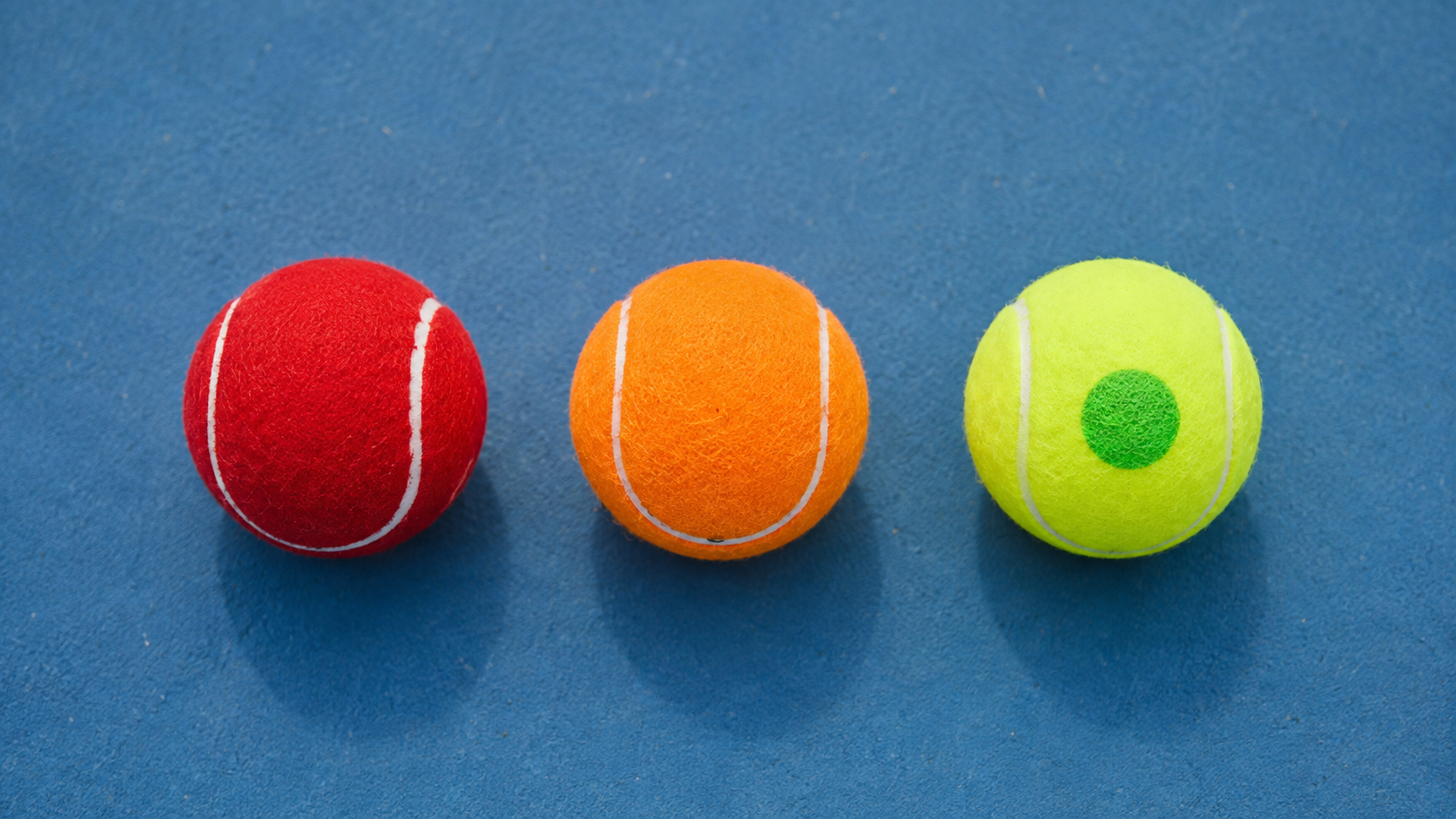
Red, Orange, Green, and the Green Dot
The colours describe the ball, and the ball sets almost everything else. Here is what each one actually means, in plain terms.
The red ball is the slowest and softest. It is foam or low-pressure felt, a little larger than a standard ball, and it travels roughly seventy-five percent slower than a yellow one. It lives on a short court, about the width of a doubles court laid sideways, with a low net. This is where the youngest kids start, often around ages five to eight.
The orange ball is the next step up. It moves about fifty percent slower than a yellow ball and plays on a three-quarter court. A child on orange is usually starting to cover more ground and rally with a bit more shape.
The green ball is where things get close to the full game. It is the same size and weight as a standard yellow ball but with about twenty-five percent less pressure, so it flies and bounces a touch slower. You will often hear it called a “green dot” ball, because it is marked with a small green dot to tell it apart from a full-pressure yellow ball that looks identical. Green plays on a full-size court with a regular net. It is the last stop before a child is hitting with a standard yellow ball on the same court the pros use.
Notice what is changing as the colours move. The ball speeds up, the court grows, and the racquet lengthens. Every one of those changes asks more of the player. That is the whole design. Each colour hands a child a challenge they can actually meet, then hands them a slightly bigger one when they are ready for it.
Why a slower ball teaches faster
This is the part that feels backwards to a lot of parents, so it is worth sitting with.
A faster ball does not teach a child faster. It usually teaches them worse.
Watch what happens when you put a small beginner on a full court with a real yellow ball. The ball arrives before they are set. It bounces up past their shoulder. They reach, they lunge, they slap at it late, and they miss most of them. What they are learning in that moment is not tennis. It is panic, and a rushed, arm-only swing that a coach then has to spend years undoing.
Now slow the ball down and shrink the court. Suddenly the child has time. The ball meets them at a comfortable height, out in front of their body where a good contact point lives. Research on scaled tennis equipment has found exactly this. When young beginners use lower-compression balls and appropriately sized racquets, they make contact in front and to the side of the body and swing from low to high far more often, which is the foundation of every real groundstroke. They also simply hit more balls back, and rallying is how the game is learned.
Parents often assume the harder ball is the more advanced training, the way heavier weights mean a harder workout. In reality, the slower ball is not making tennis easier. It is making tennis learnable. The speed comes later, once the movement underneath it is sound.
The colours are about equipment, not a report card
If there is one idea to carry out of this article, it is this. The colour of your child’s ball tells you what equipment gives them the best chance to learn right now. It does not tell you how talented they are, and it is not a grade.
Two kids the same age can sit at different colours for reasons that have nothing to do with ability. One has been playing since she was four. One picked up a racquet last month. One is tall and coordinated for his age. One is still growing into his feet. None of that is a verdict on how good they will be at twelve, or sixteen, or thirty-five.
This matters because the pressure to move up is real, and it almost never comes from the child. It comes from the fence. A parent sees another kid on orange and reads it as a scoreboard. The trouble is what moving up too soon actually does. It takes a child who was rallying with confidence and margin and drops them into a ball moving faster than they can read, on a court bigger than they can cover. The rallies collapse. The swing shortens back into a panic-slap. The fun leaks out.
A child who is a little bored on red is fine. A child who is drowning on orange is a problem that can take a season to fix.
Age tells you where to start, not when to move
The stage charts all list age ranges, and those ranges are useful. A five-year-old belongs on red. A ten-year-old who has never played does not belong on a full-pressure yellow ball just because of the number on their birthday cake. Every youth sport runs into this. It is the same tension behind the U-age brackets in Canadian soccer, where the birth year sets the group and everything else sets the player.
But age is where you start the conversation, not where you end it. Two things matter more than the calendar. The first is the body, meaning size, strength and coordination. The second is time in the sport, meaning how many hours a child has actually spent rallying. A tall, athletic eight-year-old who has played for two years and a small seven-year-old in her first month might both be exactly where they should be, on two different colours.
Children do not graduate to the next ball because they had a birthday. They progress because they are ready. Those are different things, and the difference is the entire point.
How a coach knows a child is ready
So how do we actually decide. Not by age, and not by how badly a parent wants it. We watch four things.
We watch whether the rally holds. A child who is ready to move up can keep a ball going with a partner without the point falling apart every second shot. We watch the contact point, whether they are meeting the ball out in front or still catching it late and cramped. We watch court coverage, whether they can recover after a shot and get to the next ball, because the next colour will hand them more ground to cover. And we watch decisions, whether they are starting to aim the ball somewhere on purpose rather than just getting it back.
Put simply, a child is ready to move up when the current stage has become comfortable and a little too easy. They are winning points with room to spare. The challenge has drained out of it. That is the moment the next ball helps, because it restores the challenge without tipping into chaos.
You can usually see the right stage from the fence, too. Your child is in the right place when the rallies are happening, when they are being stretched but not overwhelmed, and when they still want to come back next week. That last one is the most important reading on the dial.
Choosing a tennis program that keeps a kid playing
Not every program runs progressive tennis well, so it is worth knowing what good looks like before you enrol.
Look for coaches who use the staged equipment on purpose and can explain why, not ones who put every kid on a yellow ball because that is what a real racquet club looks like. Look for small groups and a lot of actual ball-striking, kids rallying and playing points early, rather than long lines waiting for a turn. Look for an environment built around fun and long-term participation instead of early results, because the healthiest young player is simply the one who is still playing in ten years. A program running Rogers First Set, or built on the same red-orange-green model, is usually a good sign.
And ask one direct question. How do you decide when a child moves up. A good coach will have a real answer about rallies and readiness. If the answer is only about age, keep looking. It belongs on the short list of questions worth asking before you register anywhere.
I made the broader case for the sport elsewhere, in is tennis the healthiest sport for kids? The short version is that tennis is one of the few games a person can play at six and at sixty. The colours exist to get your child onto that path and keep them there.
The colours were never the point
It is easy, standing at the fence, to turn a child’s tennis into a ladder and start counting the rungs. Red, then orange, then green, then the real thing, faster please.
But the ladder was never the point. The point is a child who reaches for a ball she has no business getting to, gets a racquet on it, sends it back, and laughs. The colour under that moment will change on its own, quietly, at the right time, and you will barely notice the day it happens. What you will notice is a kid who wants to play again tomorrow. Get that right and the rest takes care of itself.
Find and compare tennis programs and clubs on the GoPlay platform. Registration is free. Visit: app.goplay.ai or click the button below
Frequently Asked Questions
What do the red, orange, and green tennis balls mean?
They are the stages of progressive tennis, and each colour is a ball scaled to a child’s stage of development. Red is the slowest and softest and plays on a short court, orange is a step faster on a larger court, and green is close to a full yellow ball on a full court. The colours change the speed of the ball and the size of the court so a child is always playing a version of tennis they can actually rally in. They describe the equipment a child is using, not how good they are.
What age should my child start with a red ball?
Most children start on red somewhere around ages five to eight, and some age-appropriate programs begin even younger. The red ball is soft, slow and a little oversized, which lets a young child track it and hit it without feeling rushed. Age is only a starting guide, though. What matters more is that the child can rally and enjoy it, which the red ball is designed to make possible from the first session.
When should my child move up to the next ball colour?
When the current stage has become comfortable and a little too easy. A child is ready when they can keep a rally going, meet the ball out in front, cover the court, and start placing shots on purpose, all with room to spare. Moving up before that trades a confident player for an overwhelmed one. There is no prize for reaching yellow early, so let readiness lead.
Is the red ball too easy for my child?
If your child is rallying well and clearly winning points with margin, the red ball may have done its job, and that is worth mentioning to their coach. But “too easy” is exactly the right condition to be in just before moving up, not a sign the stage was a waste. A child who looks like they are cruising on red is building the movement and contact that the faster balls will demand later. Boredom is a signal to progress, not proof the colour was beneath them.
Can my child skip a stage?
Occasionally, but it is rare and it should be a coach’s call, not a shortcut. The stages exist because each one builds something the next one needs, so skipping usually just moves a gap further down the road. A child who arrives with real experience from another racquet sport might slot in higher than their age suggests. For most kids, moving through the stages in order is what makes the progress stick.
What is a green dot ball, and how is it different from a regular tennis ball?
A green dot ball is the same size and weight as a standard yellow ball but has about twenty-five percent less internal pressure, so it flies and bounces a little slower. It is marked with a small green dot precisely because it looks identical to a full-pressure yellow ball otherwise. That small drop in speed is enough to help a child transitioning to the full court keep control while they adjust. It is the last step before a standard yellow ball.
Does my child need a different racquet for each stage?
Racquet length does increase as children move through the stages, roughly from nineteen to twenty-three inches at red up toward twenty-six inches at green. A racquet sized to the child helps them swing properly rather than muscling an adult frame around. You do not need anything expensive, and many programs supply appropriately sized racquets for beginners. It is worth checking the length matches your child’s stage before buying, and worth knowing what a season in youth sport tends to cost before you commit to more than one.
My child is tall for their age. Should they be on a faster ball?
Not automatically. Height helps with reach, but it does not by itself give a child the timing, coordination and rally consistency that the faster balls demand. A tall beginner still needs to learn to meet the ball out in front and control a rally, and the slower ball is where that gets built. Let the coach base the decision on how your child is actually playing, not on how they measure up.
What is Rogers First Set?
Rogers First Set is Tennis Canada’s national program for introducing kids to the game, delivered with partners and community coaches across the country. It is built on the red, orange and green progressive tennis stages, with the goal of letting young players rally and enjoy tennis from the start rather than waiting until they can handle a full court. If a local program runs it, that is usually a good sign the equipment and coaching are matched to young players. You can compare local tennis programs and clubs on GoPlay to find options near you.
How do I know if my child is in the right stage?
Watch the rallies and watch their face. A child in the right stage is being challenged but not overwhelmed, hitting plenty of balls back, and still wanting to come back next week. If every point collapses in a scramble, the stage may be too fast for now. If they look bored and are winning easily, they may be ready to move up, which is a conversation to have with their coach.