
Olympic Weightlifting for Kids: A Parent’s Guide to Getting Started

  • ,
    Olympic Weightlifting for Kids: A Parent’s Guide to Getting Started

    A few times every month, I get some version of the same message from a parent. Usually it starts with hesitation.

    “My kid saw Olympic weightlifting online and now they won’t stop talking about it. Is this actually safe?”

    Sometimes, it is simply: “Are they too young to start lifting?”

    A lot of parents still hear “weightlifting” and picture kids trying to move massive weights with bad technique and no supervision. That is not what a good youth program looks like. 

    Olympic weightlifting, when coached properly, is one of the most structured and carefully progressed sports a young athlete can do. Most beginner athletes spend far more time learning how to move than they do lifting heavy weight.

    If your child is interested in the sport, here is what parents should know before getting started.

    What parents usually misunderstand about Olympic weightlifting

    A few times every month, I get some version of the same message from a parent. Usually it starts with hesitation.

    “My kid saw Olympic weightlifting online and now they won’t stop talking about it. Is this actually safe?”

    Sometimes, it is simply: “Are they too young to start lifting?”

    A lot of parents still hear “weightlifting” and picture kids trying to move massive weights with bad technique and no supervision. That is not what a good youth program looks like. 

    Olympic weightlifting, when coached properly, is one of the most structured and carefully progressed sports a young athlete can do. Most beginner athletes spend far more time learning how to move than they do lifting heavy weight.

    If your child is interested in the sport, here is what parents should know before getting started.

    What parents usually misunderstand about Olympic weightlifting

    Olympic weightlifting revolves around two lifts: the snatch and the clean and jerk. The snatch moves the bar from the floor to overhead in one movement, while the clean and jerk brings the bar to the shoulders first before driving it overhead.

    When parents watch elite lifters at the Olympics, they usually notice the weight first. Coaches tend to notice something else entirely: timing, coordination, mobility, balance, and speed. Those are really the qualities the sport develops.

    A good youth weightlifting program is not trying to create tiny powerlifters. It is teaching kids how to move properly, become more coordinated, and develop explosive athletic ability safely over time. That is one reason the sport transfers so well into hockey, soccer, basketball, football, volleyball, and track. Most sports reward explosiveness. Very few actually teach it directly.


    Find and compare weightlifting programs for kids on the GoPlay platform. Registration is free. Visit: https://app.goplay.ai or click the button below

    Why the safety concerns are usually overblown

    The first concern most parents raise is injury risk, which makes sense because the sport looks intense from the outside. But supervised Olympic weightlifting actually has one of the lower injury rates among youth sports, especially compared to contact sports like hockey and football. Weightlifting Canada and the Ontario Weightlifting Association both maintain extensive coaching and certification standards around youth development and safety.

    The bigger issue is not the sport itself. It is the quality of the coaching.

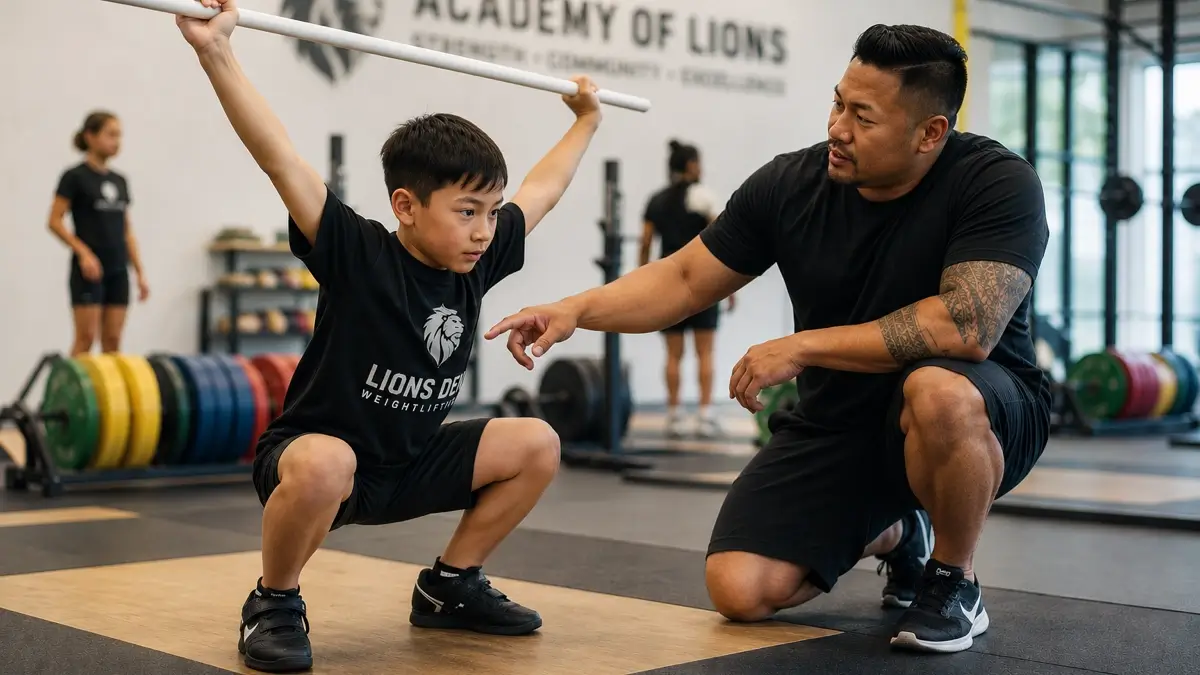
    Parents should pay close attention to how beginner athletes are coached and progressed. A strong youth program does not rush kids into heavy lifting, chase ego-driven numbers, or sacrifice movement quality for intensity. At Lions Den, beginners spend time with PVC pipes, light bars, and movement drills long before heavier loads are introduced. Kids learn positions, timing, balance, and control first. The technique leads, and the weight follows.

    The other concern parents bring up constantly is growth plates and stunted growth. Sports medicine research has repeatedly shown that supervised strength training does not harm healthy bone development in children. In many cases, properly structured strength training improves bone density and long-term athletic development. The important part is that the training is supervised, progressive, and technically sound.

    What age kids are usually ready to start

    I have worked with athletes as young as eight years old, although that does not mean every eight-year-old is ready for a structured weightlifting environment. The better question is whether a child can follow instruction, stay focused through a session, handle structure, and accept coaching corrections.

    For a lot of kids, things really start to click somewhere around ages 10 to 12. That is often when coordination and attention span begin lining up with the technical side of the sport. Still, every athlete is different. Some younger kids pick things up immediately, while some older beginners need more time.

    Parents sometimes worry their child is “behind” because another athlete progresses faster. In practice, that concern usually fades once kids settle into the process. Olympic weightlifting rewards patience more than almost any other sport.

    What parents should look for in a youth program

    The way coaches interact with beginners tells parents a lot about the quality of a program. Corrections should be calm, specific, and constructive. Young athletes should look engaged and supported, not intimidated or rushed. Watching a session in person is often more revealing than anything written on a website.

    Coaching credentials matter too. In Canada, coaching certifications typically run through the National Coaching Certification Program alongside Weightlifting Canada. Qualified coaches should be comfortable explaining how they progress beginners, how they approach safety, and what early-stage training looks like for younger athletes.

    Parents should also pay attention to the overall culture of the gym. The strongest youth environments are usually focused without feeling tense or overly competitive. Kids encourage each other, mistakes are treated as part of learning, and beginners are not made to feel like they are behind.

    Most young athletes do not walk into a gym full of confidence. A lot of them are awkward at first. Good coaching accounts for that and builds athletes gradually over time.

    What your child’s first few months should actually look like

    One thing parents are often surprised by is how technical beginner training really is. Early sessions usually focus heavily on movement prep, mobility, positions, timing, and body awareness. A lot of beginners spend time working with PVC pipes or light training bars while they learn movement patterns. That is exactly how it should look.

    As athletes improve, coaches gradually layer in squats, pulling variations, pressing work, core development, jumping drills, and explosive movements. The goal early on is not to see how much weight a child can lift. It is to help them become better movers and more coordinated athletes overall.

    The best youth programs also keep sessions engaging because kids learn faster when they enjoy being there. Good coaches understand that balance between structure and energy.

    Questions to Ask a Kids Weightlifting Coach

    Before enrolling your child in a youth Olympic weightlifting program, it helps to ask a few direct questions. A good coach should be comfortable answering all of them clearly.

    • How are beginners introduced to the sport?
    • How long do new athletes spend learning technique before lifting heavier weight?
    • Do beginner athletes start with PVC pipes or light training bars?
    • What coaching certifications do you hold?
    • How many kids are typically supervised during a session?
    • How do you correct mistakes or unsafe movement patterns?
    • How do you handle athletes who progress at different speeds?
    • What does a typical beginner session look like?
    • How do you balance competition with long-term athletic development?
    • Are kids encouraged to play other sports alongside weightlifting?
    • What steps do you take to prevent injuries?
    • How do you communicate with parents about athlete progress?
    • Can parents watch a session before registering?
    • What should parents expect during the first few months?
    • How do you keep younger athletes engaged while still teaching proper technique?

    Be sure to attend a session in person. It is the best way to evaluate a program. Pay attention to how coaches speak to kids, how athletes interact with each other, and whether the environment feels supportive, structured, and safe. The strongest youth programs are typically disciplined without feeling intimidating.

    What parents usually notice after a few months

    The physical changes are obvious, but the more meaningful changes usually happen outside the gym.

    After a few months, parents notice that their child seems more confident. They focus better. They handle frustration differently. They stop quitting as quickly when something gets difficult.

    A lot of that comes from the nature of Olympic weightlifting itself. In this sport, everybody misses lifts. Beginners miss lifts. National-level athletes miss lifts. Olympians miss lifts. You put yourself out there, attempt something difficult, fail sometimes, and then learn to reset without falling apart.

    Over time, kids start realizing that failure is not catastrophic. It is feedback. It is part of improvement. That lesson carries into school, other sports, friendships, and eventually adulthood. The platform becomes a place where kids slowly build resilience without even realizing they are doing it.

    And honestly, that is the part that matters most. 

    The medals are great when they happen. Progress in the gym is rewarding too. But watching a young athlete become more confident, more patient, and more comfortable with challenge over time is usually the real win.


    Find and compare weightlifting programs for kids on the GoPlay platform. Registration is free. Visit: https://app.goplay.ai or click the button below


  • What Playing Pro Football Taught Me About Discipline, Kids, and Long-Term Success

    Discipline doesn’t show up on game day. By then, it’s already built. What you’re seeing is the result of thousands of reps nobody ever watched. That’s the part most people miss, especially when it comes to kids and athletic success.

    When I watch youth sports now, the biggest gap isn’t talent or coaching. It’s how we think about development. There’s a tendency to look for progress early, whether that’s performance, recognition, or advancement. But the habits that lead to long-term success don’t look impressive at the start. They’re repetitive, sometimes frustrating, and easy to overlook if you’re focused on outcomes. That’s where discipline either takes hold or doesn’t.


    Find programs and gyms that help your young athlete be their best at their sport on the GoPlay platform. Registration is free. Visit: https://app.goplay.ai or click the button below


    How Discipline Actually Gets Built

    When I first stepped into a professional football environment, what stood out wasn’t intensity in the way most people expect. It wasn’t loud or chaotic. It was controlled, consistent, and deliberate. Practice had a rhythm to it. Routes were run the same way again and again, timing was refined in small increments, and details were repeated until they became automatic.

    It wasn’t about proving anything that day. It was about building something that would hold up later, when the pressure was real and there was no time to think.

    That’s very different from how kids often experience sports. In practice, I tend to see one of two extremes. Either things are too loose, where attendance and effort vary and kids never settle into a rhythm, or everything becomes structured and outcome-driven too early, before the child is ready for it. Neither approach builds real discipline.

    For younger kids, discipline is much more basic than people expect. It’s about showing up regularly, staying engaged, and beginning to understand that effort leads to improvement. That connection takes time, but once it forms, everything else becomes easier to build on top of it.

    Why Pushing Too Early Backfires

    There’s a common assumption that discipline comes from doing more, earlier. More training, more structure, more focus on one sport.

    At the professional level, it actually works the opposite way. Workload is managed carefully. Intensity is controlled. There’s a clear understanding that development happens over time, not all at once.

    With kids, when you push too early, you don’t create discipline. You create resistance.

    In practice, it shows up gradually. Kids lose interest, hesitate before sessions, or start going through the motions without real engagement. It’s not that they lack ability or effort. It’s that the environment has moved beyond what they’re ready to handle. Once that happens, it becomes much harder to rebuild the connection between effort and progress. That’s where a lot of development stalls.

    Research has shown that early specialization increases both injury risk and burnout without improving long-term outcomes. What it really does is shorten the window where discipline could have developed naturally.

    If you want discipline to stick, it has to be built at a pace the child can sustain.

    There are exceptions to this. Some sports do require earlier specialization if a child wants to compete at an elite level. That’s just the reality of how those pathways are structured.

    But even in those cases, the same principle applies. The decision should come from the child’s genuine interest, not pressure from the outside.

    When a kid truly loves one sport, it’s fine to lean into that. The key is paying attention to the signals. If enthusiasm drops, if performance suddenly dips without explanation, or if aches and pains start to show up more often, those are early warning signs that the balance is off.

    Discipline doesn’t come from narrowing things too quickly. It comes from staying engaged long enough for the habits to take hold.

    Practical Guardrails

    There are also practical guardrails that can help parents manage this balance.

    A useful guideline many coaches follow is that children should spend no more hours per week in organized sport than their age. A 10-year-old, for example, should generally not exceed 10 hours per week.

    When that threshold is exceeded, the risk of burnout and long-term physical injury starts to rise. That doesn’t mean it can’t be done, but it does mean the trade-offs should be understood clearly.

    To manage that risk, a few simple rules tend to make a meaningful difference:

    • One full day off from organized sport each week
    • No more than a 10 per cent increase in training volume at a time
    • At least three months of cumulative rest across the year to allow for both physical recovery and mental reset

    These aren’t about limiting potential. They’re about protecting it over the long term.

    Why Variety Strengthens Discipline

    There’s a concern I hear often from parents that if their child doesn’t focus early, they’ll fall behind. The assumption is that discipline comes from committing to one thing as soon as possible. But, from what I’ve seen, especially at higher levels, the opposite is usually true. Variety doesn’t weaken discipline. It reinforces it.

    This doesn’t mean every child needs to stay general forever. Some will naturally gravitate toward one sport. The difference is whether that focus is chosen or imposed.

    When kids move between activities, they’re still learning the same underlying habits. Showing up, listening, adjusting, working through mistakes. Those behaviours carry across environments and tend to stick better because the experience stays engaging.

    There’s also a physical benefit. Different activities challenge different movement patterns, which helps reduce the risk of overuse injuries that come from repeating the same motions year-round. The challenge for most families isn’t understanding this. It’s coordinating it.

    Schedules fill up quickly. Registration windows are tight. Decisions get made based on what’s available instead of what actually makes sense long term. Being able to step back and compare kids sports programs or seasonal options in one place makes a real difference.

    Consistency Is What Builds Long-Term Success

    If there’s one principle from pro sport that applies directly to kids, it’s this. Consistency is what drives everything.

    You don’t need extreme intensity to build progress. You need regular participation over time. Two or three steady sessions a week will outperform inconsistent bursts of effort every time, because consistency allows skills to compound.

    In practice, the kids who improve aren’t always the most naturally talented. They’re the ones who keep showing up. They settle into a rhythm, start to see small improvements, and those improvements reinforce their effort. That’s where discipline actually forms.

    Once a child understands that effort leads to progress, they stop needing to be pushed. They start taking ownership, and that’s when development really accelerates.

    Signs the Environment Is Moving Too Fast

    Parents often ask how to tell the difference between a healthy challenge and too much pressure. In most cases, the signs show up in behaviour before anything else.

    • A noticeable drop in enthusiasm before practices or games
    • Sudden dips in performance without a clear reason
    • Frequent complaints about soreness or minor injuries
    • Hesitation, anxiety, or resistance around participation
    • Going through the motions without real engagement

    When you see these patterns, it’s usually not about effort or attitude. It’s a signal that the environment has outpaced the child’s readiness.

    What Long-Term Success Really Means

    Very few kids will play sports at a professional level, but that doesn’t make what they’re doing any less important. In many ways, it makes it more important to get it right.

    The real value of sport is in the habits it builds. Confidence, resilience, time management, and the ability to stick with something that isn’t immediately rewarding. Those are the outcomes that carry forward.

    When you take a long-term view, your decisions change. You stop asking whether your child is ahead right now and start asking whether the environment they’re in is helping them grow. That includes how activities fit together.

    Looking at after-school programs, sports, and summer camps as part of a broader plan helps reduce stress and gives kids the space they need to develop properly. It also makes it easier to maintain the consistency that discipline depends on.


    Find programs and gyms that help your young athlete be their best at their sport on the GoPlay platform. Registration is free. Visit: https://app.goplay.ai or click the button below


    FAQ: Discipline, Kids, and Long-Term Success

    Here are frequently asked questions about kids, self-discipline and success.

    What does discipline actually mean for kids in sports?

    For kids, discipline is about consistency rather than intensity. It shows up as regular participation, staying engaged during sessions, and learning how effort leads to improvement over time. These habits are simple at first, but they become more structured as the child develops. Discipline becomes internal when kids begin to take ownership of their effort.

    At what age should kids start developing discipline?

    Discipline begins early, but it looks different depending on the stage. At ages 5 to 8, it’s about showing up and participating. Between ages 9 to 12, it becomes more about consistency and learning to focus. By the early teen years, discipline includes accountability and the ability to work through challenges without losing engagement.

    Why is consistency more important than intensity?

    Consistency allows skills to build gradually and predictably. When kids participate regularly, they begin to see progress, which reinforces their effort and motivation. Intensity without consistency often leads to uneven development and frustration. Over time, steady repetition is what produces lasting results.

    Can discipline be taught, or does it develop naturally?

    Discipline can be taught, but it develops through environment rather than instruction. Kids build discipline when they are placed in situations that reward consistency and effort. Over time, they begin to associate those behaviours with improvement. That’s when discipline becomes something they own.

    Where can I find a coach or program to help my youth athlete with performance?

    Sign up and search the GoPlay.ai platform for programs, coaches and trainers (including the Youthlete Academy) run by this post’s author. Visit: https://app.goplay.ai/signup

    What happens when kids are pushed too hard too early?

    When kids are pushed too hard too early, they often lose engagement. The environment becomes stressful rather than developmental, which can lead to burnout or withdrawal. Research shows that early pressure and specialization increase the risk of injury and dropout. Sustainable development requires pacing.

    How does enjoyment affect discipline?

    Enjoyment plays a major role in maintaining consistency. Kids who enjoy their activity are more likely to keep showing up, which is essential for building discipline. Without enjoyment, participation becomes inconsistent and development slows. Discipline depends on staying engaged long enough for habits to form.

    Why do some talented kids fail to progress?

    Talent can create early success, but without discipline, it doesn’t last. As competition increases, effort and consistency become more important than natural ability. Kids who rely on talent alone often struggle to adapt, while those with strong habits continue improving. Over time, discipline becomes the deciding factor.

    Does playing multiple sports help build discipline?

    Yes, because it reinforces consistent habits across different environments. Kids learn to adapt, stay engaged, and apply effort in different settings. It also reduces burnout and injury risk by varying physical demands. Studies have shown that varied participation supports long-term development.

    How can parents support discipline without adding pressure?

    Parents can support discipline by focusing on consistency and effort rather than results. Encouraging regular participation and recognizing improvement helps build confidence. Avoiding constant comparison or pressure allows kids to develop at their own pace. The goal is to support, not control.

    How do you know if discipline is developing properly?

    You’ll see it in behaviour over time. Kids begin to show up consistently, stay engaged during sessions, and handle challenges without immediately wanting to quit. Progress may be gradual, but their approach becomes more steady and self-driven. That’s a strong indicator that discipline is taking hold.