
Parents often ask this simple question during the soccer season: How can my child get better at soccer?
Sometimes the query comes after a difficult game or when their child suddenly wants to practice every day in the backyard. Some parents simply want to support their child’s interest in the sport without pushing too hard.
The honest answer is that getting better at soccer rarely comes from a single drill, a weekend camp, or a new pair of cleats. Improvement always happens gradually. It comes from repeated touches on the ball, confidence built over time, and experience playing in real games.
A six-year-old learning to dribble should not train the same way as a fourteen-year-old learning tactics and positioning. Youth soccer in Canada is structured around ages and stages of development. When players focus on the right skills at the right age, improvement tends to follow naturally.
Parents who understand those stages often find it much easier to support their child’s progress.
If you’re just getting started or trying to make sense of how everything fits together, it helps to understand how youth soccer is structured across Canada. From age group systems and skill development to competitive pathways and what to expect as a parent, there’s a bigger picture behind each local program. You can explore our complete guide to youth soccer in Canada for a clear breakdown of how it all works, along with answers to common questions parents have as their children move through the sport.
Understanding the U-Age System in Youth Soccer
Youth soccer in Canada is organized by age groups such as U8, U10, or U14. The “U” simply means “Under.” So for example, the U10 team is made up of players who are under the age of 10 during that season. U10 = Under 10 years old.
Leagues use these divisions so children compete with players who are in roughly the same stage of development as they are and within a year or so of their age.
You can see a breakdown in the next section, however if you want to dive deeper, you can read a full explanation in this related article on our site: Understanding the U-Age System in Canadian Youth Soccer.
Soccer Skills Improvement By Age Group
As with any sport, youth soccer players improve as they grow. The table below shows the typical focus at each stage of development in soccer. Most youth soccer programs in Canada follow a similar progression.
| Division | Typical Player Age | Main Development Focus |
| U5-7 | 4–6 years old | Basic movement, coordination, and fun |
| U8 & U9 | 7&8– years old | Movement, technical development, fun |
| U10 & U11 | 9 & 10 years old | Movement, technical development, fun |
| U12 & U13 | 11 & 12 years old | Technical development, decision making, teamwork |
| U14 & U15 | 13 & 14 years old | Tactical awareness, game understanding, athletic development, mental preparation |
| U16 | 15 years old | Tactical awareness, game understanding, athletic development, mental toughness |
| U18 | 16–17 years old | Position specialization, technical refinement, preparing to win |
Each stage builds on the one before it. Younger players focus on coordination and comfort with the ball, while older players begin to understand strategy, teamwork, and game management. These stages are outlined further in Canada Soccer’s Long Term Player Development Pathway (loads a PDF file).
Understanding Your Child’s Soccer Development Journey
As kids grow in soccer, what they need and how they learn changes. The Long-Term Player Development (LTPD) model is a framework used in youth soccer to match training, competition, and expectations to a child’s stage of development.
Instead of pushing kids too hard too early, LTPD focuses on building the right skills at the right time. It starts with fun and movement, then gradually adds technical skills, teamwork, and competitive play.
The goal is simple: help kids enjoy the game, stay in it longer, and reach their full potential, whether that’s recreational play or elite competition.
Active Start (U4 to U6)
This is where the journey begins. At this stage, young players are introduced to basic movement skills such as running, jumping, landing, kicking, throwing, and catching. Sessions are centred around fun, informal play and positive encouragement. The goal is simple, to help children build confidence, stay active, and enjoy being part of the game.
Fundamentals (U6 to U8 for girls, U6 to U10 for boys)
As players grow, the focus shifts toward developing the building blocks of movement. This includes agility, balance, coordination, and speed. Players are also introduced to the basics of soccer in an environment that emphasizes fun, cooperation, and plenty of time on the ball. At this stage, enjoyment and engagement remain the priority.
Learning to Train (U8 to U11 for girls, U9 to U12 for boys)
Often referred to as a key development window, this stage is where players begin to truly learn how to play. Children become more capable of understanding feedback, reflecting on their actions, and learning from mistakes. Training focuses on developing a wider range of soccer skills and introducing simple principles of play in a fun and challenging environment.
Across all three of these early stages, there are no league standings and no emphasis on results. The priority is to help children develop skills, confidence, and a genuine love for the game.
Training to Train (U11 to U15 for girls, U12 to U15 for boys)
As players move into adolescence, their experience becomes more structured. This stage often coincides with rapid physical growth, making it an ideal time to develop endurance. Players are introduced to concepts such as goal setting, mental preparation, and managing both success and setbacks. Technical development continues, including more advanced and position specific skills.
Training to Compete (U15 to U19 for girls, U16 to U20 for boys)
At this stage, players begin to apply their skills in more competitive environments. The game is now played in its full format, and players focus on refining their techniques while developing tactical awareness, discipline, and mental toughness. Training prepares players to perform consistently under pressure.
Training to Win (U18 plus for girls, U19 plus for boys)
For players who progress to higher levels, the focus shifts to performance. Most core skills are now well established, and the emphasis is on maximizing potential. Players work on adapting to different game situations, establishing strong pre training and pre match routines, and maintaining peak physical and mental condition.
A pathway for every player
It is important to recognize that every player’s journey is different. While some may pursue high performance opportunities, others may choose to continue playing recreationally. Both pathways are equally important.
The Long Term Player Development model is designed to support all players by focusing on age appropriate development and positive experiences. When children are given the right environment at the right time, they are more likely to enjoy the game, improve their skills, and stay involved for life.
What New Soccer Parents Need to Know About Player Development
I wanted to make mention at this point about expectations around improvement in youth soccer. It never happens overnight and is usually a progression that you can see over a season (five to six months), but not necessarily game to game, although it is exciting to see when it does.
Parents sometimes expect progress to show up in obvious ways, such as scoring more goals or running faster than other players. In reality, development usually appears through smaller changes.
A player who once rushed to kick the ball away might begin to control it. A player who used to chase the ball everywhere may start to think about their defensive positioning, or an attacker might position themselves correctly at the right moment. From a coaching perspective, those small changes often signal real progress.
The players who train regularly (e.g. twice a week as a minimum) and play regular games improve most consistently and are usually the ones who stay associated with the game for longer.
Simple Practice Habits That Help Players Improve
Parents often ask me what they can do outside organized practices to support their child’s development.
I tell them that the most effective approach is simple: give players regular opportunities to interact with the ball.
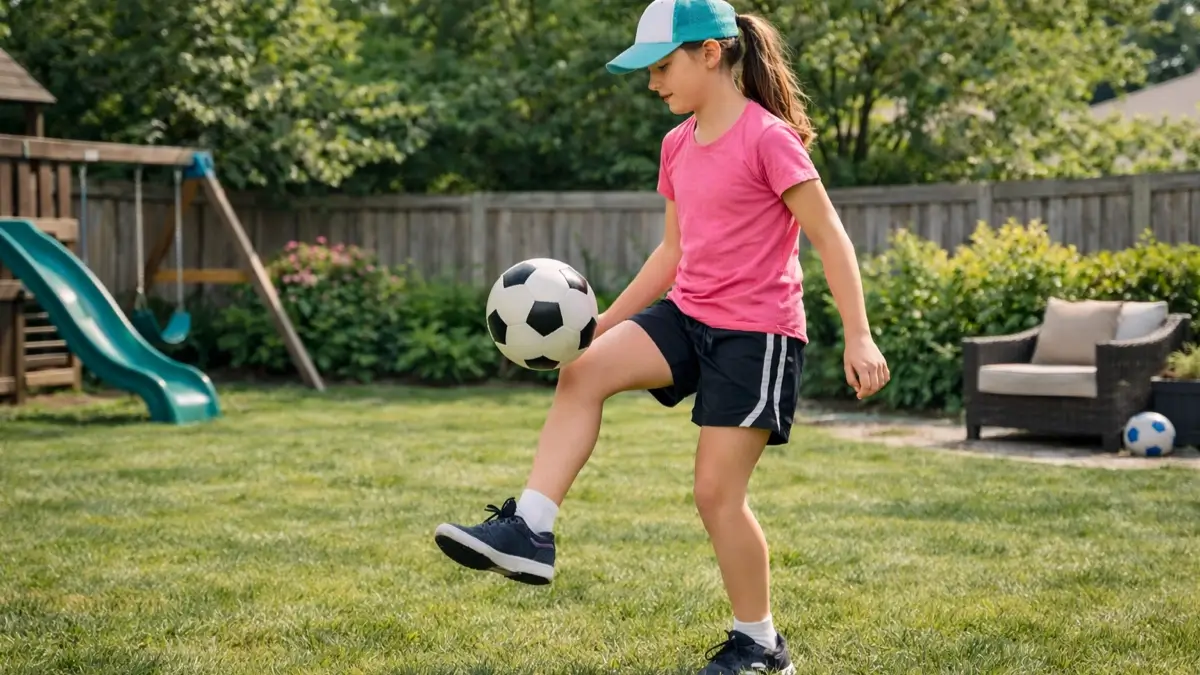
Young players benefit from activities such as dribbling around cones , passing the ball against a wall, juggling the ball (keeping it in the air using repeated touches with the feet or thighs), and playing small games with friends or siblings.
Watching soccer can also help. Many young players learn by observing how experienced players move, pass, and create space on the field.
Even ten minutes of casual practice several times a week can make a noticeable difference over time.
As you can see if you create opportunities for your child to play the sport, practice during downtime, and even watching advanced or professional players play the sport, the exposure pays off when they get onto the field.
Frequently Asked Questions
Here are a series of most frequenlty asked questions by parents (and their answers0 about how kids and youth can improve at soccer.
Most youth players improve through regular team practices and games. Practising with the ball for ten to fifteen minutes a few times each week at home can help build skills more quickly.
Ball control is the foundation of the game. Players who can dribble, stop, and pass the ball confidently tend to develop faster in other areas.
Yes. Juggling means keeping the ball in the air using repeated touches with the feet, thighs, or head without letting it hit the ground. It improves coordination, balance, and touch on the ball.
Many coaches encourage younger players to try multiple sports. Different activities help develop coordination and athletic ability that benefits soccer later.
Training often becomes more structured around the U10 to U12 stage when players begin understanding tactics and teamwork.
Private training can help older players refine specific skills, but it is not necessary for most children. Consistent team training and informal play provide strong development.
Children develop at different rates physically and mentally. Confidence, practice habits, and playing experience all influence improvement.
Yes. Watching games can help young players understand movement, teamwork, and decision-making. Expose them to professional league play and get out and watch local games as well.
Encouragement, patience, and opportunities to practise usually help more than criticism or intense expectations.
Enjoyment is the strongest motivator for kids that play soccer. Players who feel supported by coaches, teammates, and parents are more likely to continue practising and developing their skills.